
Pakistan have sealed their spot in the ICC Women's Cricket World Cup 2025 after a flawless campaign in the Qualifiers - but their participation has already stirred controversy.

Airlines waive cancellation and rescheduling fees and boost flight capacity from Srinagar.

External Affairs Minister S Jaishankar has asserted that India has zero tolerance for terrorism and will never give in to nuclear blackmail, emphasizing that New Delhi will deal with Pakistan purely bilaterally. He made these remarks during a joint press conference with his German counterpart in Berlin, where he also highlighted the importance of the strategic partnership between India and Germany, emphasizing the need for a free trade agreement between the two nations.

Lieutenant Governor Manoj Sinha asserts that the Indus Waters Treaty was a 'historic mistake' and its termination will greatly benefit Jammu and Kashmir by allowing it to harness its hydropower potential.
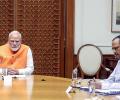
India's National Security Advisor Ajit Doval briefed US Secretary of State Marco Rubio on the country's missile strikes against nine terrorist targets in Pakistan. The strikes, dubbed "Operation Sindoor," targeted terrorist infrastructure in Pakistan and Pakistan-occupied Jammu and Kashmir. India stated that the strikes were measured, responsible, and non-escalatory in nature, targeting only known terror camps. The strikes followed a deadly attack on civilians in Jammu and Kashmir on April 22, for which India has accused Pakistan-based terrorists. The Indian government has cited credible leads, technical inputs, and survivor testimony as evidence of Pakistan's involvement in the attack.

A woman arrested for allegedly promoting Al-Qaeda's agenda had appealed to Pakistan's Army chief to invade India to unify Muslim lands under Project Khilafat, officials said.
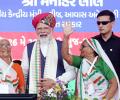
'The country that came into existence after Partition lives on hatred for India. It only wants to harm Bharat. However, India's goals are to remove poverty, bring about economic development and become a developed nation'
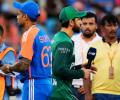
Chaudhary lauded Andy Pycroft, describing him as a seasoned ICC elite panel referee with a stellar track record and a well-known former Zimbabwean player of high repute.

Jammu and Kashmir Chief Minister Omar Abdullah has reached out to state governments where Kashmiris are allegedly being harassed following the recent terror attack in Pahalgam. He responded to reports of harassment on social media, requesting his counterparts to take extra care. The attack, which killed 26 people, mostly tourists, has sparked fear and anxiety among Kashmiris across the country.
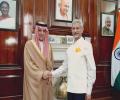
Saudi Arabia's Minister of State for Foreign Affairs Adel Aljubeir visited India on Thursday and held talks with External Affairs Minister S Jaishankar, focusing on de-escalating tensions between India and Pakistan. The visit comes as ties between India and Pakistan have further deteriorated following Indian military strikes on terror infrastructure in Pakistan. Iranian Foreign Minister Abbas Araghchi also arrived in New Delhi on a scheduled visit amidst the escalating tensions.

'I will do it again. I am ready to put my life in danger a second time. This is my land, this is my responsibility'

The 53-second video, shot using a selfie stick, showed people running for their lives, with one of them falling, apparently after being gunned down by a terrorist.
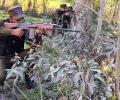
India has warned Pakistan against its unprovoked firings along the Line of Control (LoC) in Jammu and Kashmir as the directors general of military operations of the two armies spoke on the hotline amid the escalating tensions over the Pahalgam terror attack.
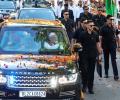
'It is important India to stay focussed on its primary national objectives: Combating terrorism; not losing sight of other security and strategic concerns (on the Sino-Indian front for instance); ensuring a strong economy and registering growth which includes improving the lot of common people; and finally making certain that the social fabric remains intact and harmony among people is not jeopardised, at least any further,' asserts Nilanjan Mukhopadhyay.
11, 13, 15 are not some random odd numbers but the number of days that Prime Minister Narendra Modi took to act against Pakistani terror strikes on Indian soil.
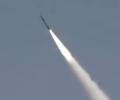
Pakistan successfully conducted a training launch of the 'Fatah series' surface-to-surface missile with a range of 120 kilometers. The launch comes amid heightened tensions with India following a terror attack in Jammu and Kashmir. The Inter-Services Public Relations (ISPR) said the test was part of the ongoing exercise 'INDUS' and was aimed at ensuring the operational readiness of troops and validating key technical parameters, including the missile's advanced navigation system and enhanced accuracy.

Prime Minister Narendra Modi raised concerns about cross-border terrorism with Chinese President Xi Jinping, advocating for India-China cooperation to combat the threat. The discussion occurred during the SCO Summit amidst efforts to rebuild bilateral relations after a border standoff.
'The fight against terrorism will continue. We have set a new normal and the new normal is that we will follow an offensive strategy. Wherever terrorists are, we have to kill those terrorists and we have to destroy their infrastructure. So it is still not over but as we speak the ceasefire is still intact'
A plea has been filed in the Supreme Court seeking the removal of Madhya Pradesh minister Vijay Shah for his remarks against Indian Army officer Col Sofiya Qureshi. The petition, filed by a Congress leader, alleges Shah's statement sparks separatist feelings and threatens the country's unity.

Shubham Dwivedi, a 31-year-old businessman from Kanpur, was shot dead by terrorists in Kashmir's Pahalgam on Tuesday, just two months after his wedding. Dwivedi was on a vacation with his wife and family when the incident occurred. The terrorists reportedly asked Dwivedi to recite an Islamic declaration of faith and shot him in the head when he failed to do so. The attack has sparked outrage and condemnation across India.

This Asia Cup has charred the relationship between India and Pakistan players.

Chief of Defence Staff Gen Anil Chauhan asserted that the armed forces are free of nepotism and urged children to join to serve the nation. He also spoke about Operation Sindoor and the use of technology in warfare.
'Pakistan is economically very weak and will not be able to sustain a war for long.'

The central government will have the power to "impose reasonable restrictions" on the international participation of Indian teams and individual athletes under "extraordinary circumstances", as per the National Sports Governance Bill that was tabled in Lok Sabha on Wednesday.
Operation Sindoor has carved out a new benchmark in our fight against terrorism, and has set up a new parameter and new normal. Operation Sindoor is not just a name but a reflection of the emotions of millions of Indians. Operation Sindoor is an unwavering pledge for justice. Terrorists dared to wipe 'sindoor' from the foreheads of our sisters; that is why India destroyed the very headquarters of terror.
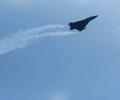
Defence experts discuss the objectives and strategic pause of Operation Sindoor, emphasizing the avoidance of a prolonged conflict and its potential impact on the Indian economy.
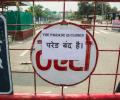
Pakistan's Foreign Minister Ishaq Dar has called for a 'composite dialogue' with India to address the contentious issues between the two sides.

Ahead of the Asia Cup, former Indian cricketer Surinder Khanna shared his views on whether the India-Pakistan clash should be played

India has opposed the International Monetary Fund's (IMF) proposal to extend fresh loans of USD 2.3 billion to Pakistan, citing concerns that the funds could be misused for financing state-sponsored cross-border terrorism. India abstained from voting at the IMF meeting, expressing concerns about Pakistan's track record and the possibility of debt financing being misused for terrorism. The IMF took note of India's statements and its abstention from the vote. India's opposition comes at a time when military conflict between India and Pakistan has intensified following a terrorist attack in Kashmir.
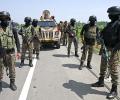
India needs to be technologically and militarily prepared to defend itself from both Pakistan and China, alerts Ramesh Menon.
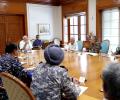
'One good outcome of Operation Sindoor -- perhaps, its best outcome -- could be that India has resumed meaningful contact directly with Pakistan at the military-to-military level,' observes Ambassador M K Bhadrakumar.
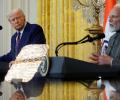
US President Donald Trump said on Friday that there has always been tension between India and Pakistan and the two countries will figure it out between themselves. Trump was asked about tensions between India and Pakistan in the wake of the Pahalgam terror attack, in which 26 civilians were killed, and if he would be talking to the leaders of the two nations. He said that he knows both leaders and that there is great tension between Pakistan and India, but there always has been.
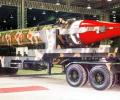
The US intelligence assessment highlights Pakistan's near-certain procurement of weapons of mass destruction-applicable goods from foreign suppliers, primarily through Chinese support.

More than one million cybersecurity incidents were flagged within 10 days.

Shaheen Shah Afridi steered clear of giving a direct response to Suryakumar Yadav's view that Indo-Pak games should not be considered a rivalry.
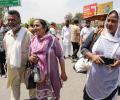
India has revoked all visas issued to Pakistani nationals effective April 27, advised Indian nationals in Pakistan to return home, and suspended visa services to Pakistani nationals. The move comes in retaliation to the Pahalgam terror attack that killed 26 people and alleged cross-border links to the attack. This escalation follows India's previous actions against Pakistan, including expelling Pakistani military attaches, suspending the Indus Water Treaty, and shutting down the Attari land-transit post.
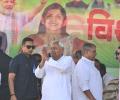
While it is evident that the INDIA bloc has not shut its doors on Nitish Kumar, those within the NDA are hopeful that the JD-U's support base would benefit them as well

PSL postponed on advice PM Sharif: PCB

Defence Minister Rajnath Singh says India achieved all objectives of Operation Sindoor, emphasizing that escalating the situation to war with Pakistan was not the aim. He highlighted India's fight against cross-border terrorism and the successful exposure of Pakistan's air defense system.
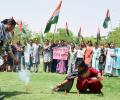
Opposition parties in India, including the Congress, Left parties, Samajwadi Party, Bahujan Samaj Party, Trinamool Congress, Dravida Munnetra Kazhagam, Rashtriya Janata Dal, Shiv Sena (UBT), and NCP (SP), have unanimously hailed the armed forces' "Operation Sindoor", a retaliatory strike against terrorist infrastructure in Pakistan and Pakistan-occupied Kashmir (PoK). The operation, which involved missile and drone strikes, was conducted in response to the April 22 Pahalgam terror attack. Despite political differences, all parties expressed support for the government and the armed forces, stressing the importance of national unity and integrity in the face of terrorism. While emphasizing the need for diplomatic avenues to prevent further escalation, some parties also called for caution in attributing political credit for the strikes.
 © 2026 Rediff.com - Advertise with us - Disclaimer - Privacy Policy - Sitemap - Feedback - About us - Terms of use - Grievances